
Inverted Spectroscopy
Inverted spectroscopy and the contribution of Compolytics to this field
The Development of Optical Spectroscopy
The development of optical spectroscopy as a scientific technique is the result of contributions from many researchers over a long period of time. The basic principles of spectroscopy were established in the early 19th century, with the work of scientists such as Joseph Fraunhofer, who discovered dark lines in the spectrum of the sun that are now known as Fraunhofer lines, as well as Gustav Kirchhoff and Robert Bunsen, who developed the laws of spectral analysis and used them to identify specific elements in the sun’s atmosphere.
Later, in the late 19th and early 20th centuries, scientists such as Johannes Rydberg, Niels Bohr, and Albert Einstein made important contributions to the theory of atomic spectra, which helped to explain the spectral lines observed in the light emitted or absorbed by atoms.
In the 20th century, spectroscopy became an essential tool for studying the structure and properties of molecules and materials, with important contributions from researchers such as Richard Feynman, who proposed the theory of quantum electrodynamics, and Gerhard Herzberg, who used spectroscopy to study the electronic structure of molecules.
Inverted Spectroscopy and its Adoption by Compolytics
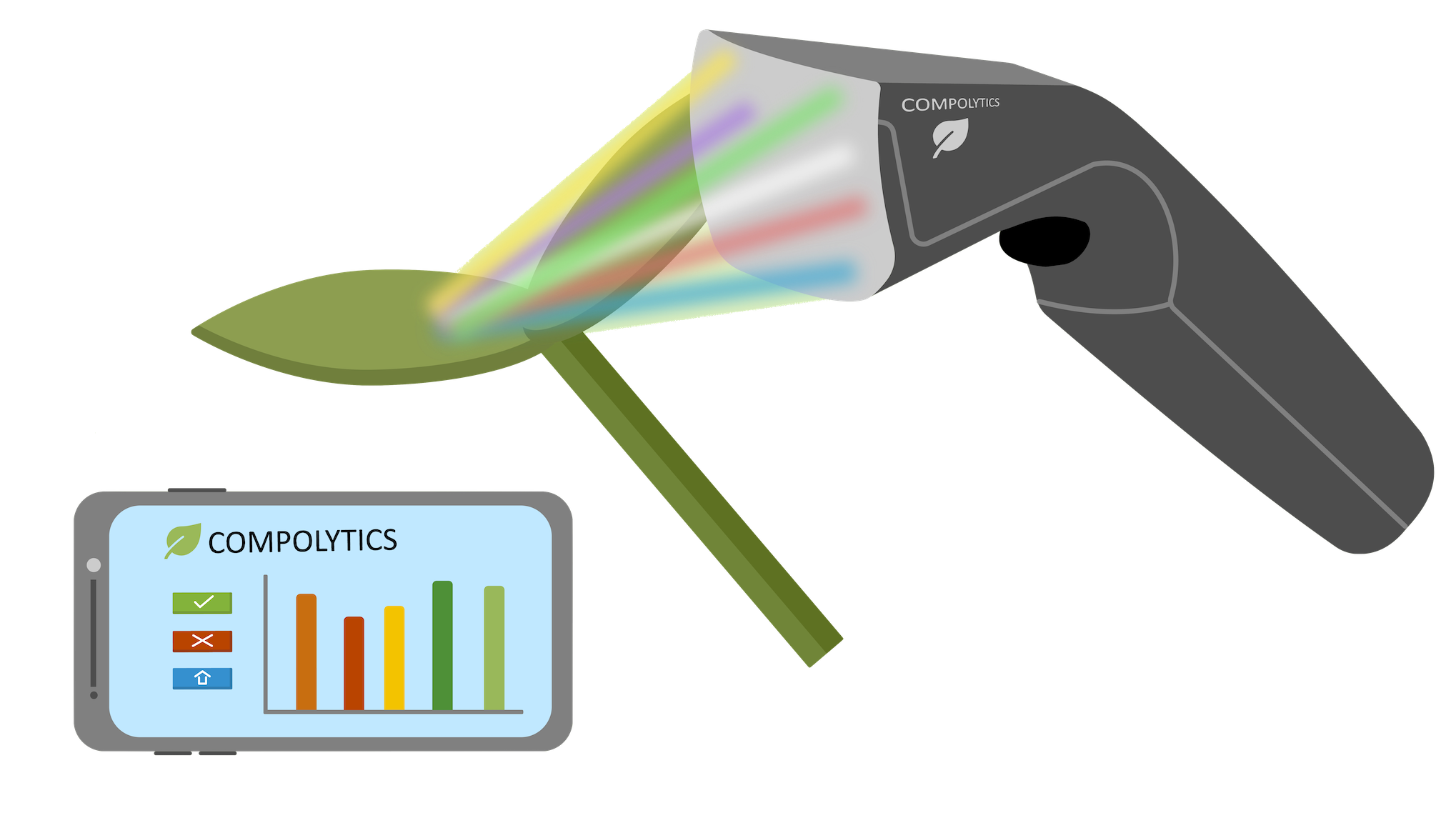
In traditional spectroscopy, a broad-spectrum light source (often halogen) is used to illuminate the sample, and a narrow-band receiver is used to measure the intensity of the transmitted or reflected light at specific wavelengths. This approach can provide information about the chemical composition and other properties of a measurement object. In contrast, in inverted spectroscopy, a set of narrow-band light sources, such as LEDs, is used to illuminate the sample with a sequence of multiple specific wavelengths (realistically very narrow ranges), and a wide-band receiver is used to measure the intensity of the transmitted or reflected light over a wide range of wavelengths.
The use of LEDs in inverted spectroscopy has several advantages over traditional techniques, including improved accuracy and sensitivity, lower power consumption, and the ability to easily adjust the wavelength of the light source. Additionally, the use of wide-band receivers allows for the simultaneous measurement of multiple spectral features, which can reduce the measurement time and increase the throughput of the system.
Compolytics has been at the forefront of developing innovative technologies based on inverted spectroscopy, a principle that revolutionises compact and efficient spectral sensing. The concept of inverted spectroscopy on smartphones was pioneered by members of our team, whose early research paved the way for a patented approach (EP3560185B1). Building on this foundation, Compolytics has integrated this innovation into our ScanCorder Smartphone platform, transforming it into a versatile tool for consumer applications. Expanding this expertise, we developed the ScanCorder Hardware sensor, extending the concept into a dedicated spectral solution with broader capabilities, including access to the UV and NIR ranges. The Macrobot NextGen combines this with automated sample handling and spatially resolved data.
Compolytics has been awarded by the German government with the label for in-house research (BSFZ) over several years.