
Fluorescence Sensing
Extending inverted spectroscopy into a new optical modality
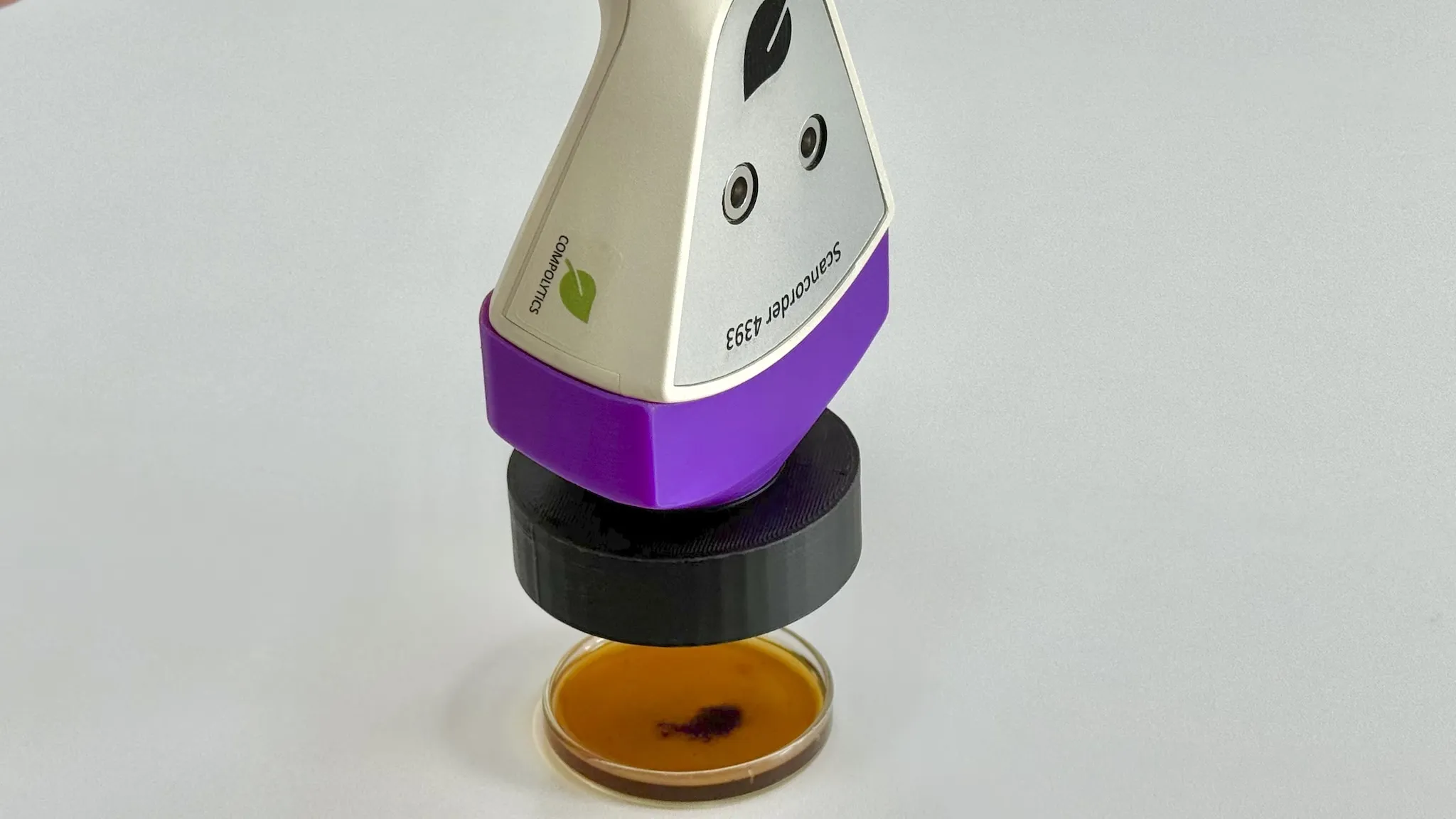
The COMPOLYTICS® ScanCorder platform extends inverted spectroscopy beyond reflectance measurements into fluorescence sensing.
Fluorescence measurements require a different optical configuration to that used for conventional reflectance sensing. A sample is illuminated at specific excitation wavelengths and the resulting fluorescence emission is detected at different wavelengths. The ScanCorder approach is particularly well suited to this principle, as its inverted spectroscopy architecture already employs individually controlled wavelengths in a sequential illumination scheme.
For fluorescence sensing, the selected illumination wavelengths can serve as the excitation bands, and several detection bands can be configured to capture the resulting emission. This allows for the creation of compact, application-specific measurement heads, where the wavelengths used for excitation and detection can be tailored to the optical characteristics of the target application.
Adaptations to the ScanCorder electronics and optical configuration were required to support excitation wavelengths in the UV range. First productive fluorescence measuring heads have been implemented with application-specific sets of excitation and detection bands.

From technology to application
The new capability has already been demonstrated through laboratory measurements conducted at several partners and customers. During the initial measurement campaign, bacteria and protein samples were examined under controlled laboratory conditions, and complementary spectral data was collected to support the development and optimisation of future sensor configurations.
This research is part of ongoing work into a multimodal optical sensor for chronic wound assessment that combines fluorescence and reflectance measurements within a single, handheld platform. These two techniques provide (partly) complementary information and may enable a more comprehensive characterisation of biological samples than either technique alone.
A demonstration experiment
The following demonstration experiment is intended to showcase this new technology independently of any specific application. Two test substances were used, for each of which the pairs of excitation and emission wavelengths are known. Given the commercial availability of LEDs and receiver channels, the optimal wavelengths are often not precisely matched (even in reflectance-only setups). However, this is not a fundamental problem, as both the emission curves of LEDs and sensitivity curves of photo-receivers have a certain width and, as a result, in many cases the signal is simply slightly weaker.
It is known from the literature:
| Substance (props used in experiment) | Excitation wavelength range | Emission wavelength range |
|---|---|---|
| Fluorescein (1 g/l in water) | 485 nm – 491 nm | 514 nm |
| Riboflavin (10 g/l in water) | 270 nm / 370 nm / 450 nm | 525 nm – 540 nm |
| Reflectance pad (PTFE, 99%) | no fluorescence, only very high reflectance | |
| Sugar solution (10 g/l in water) | no fluorescence, reference solution |
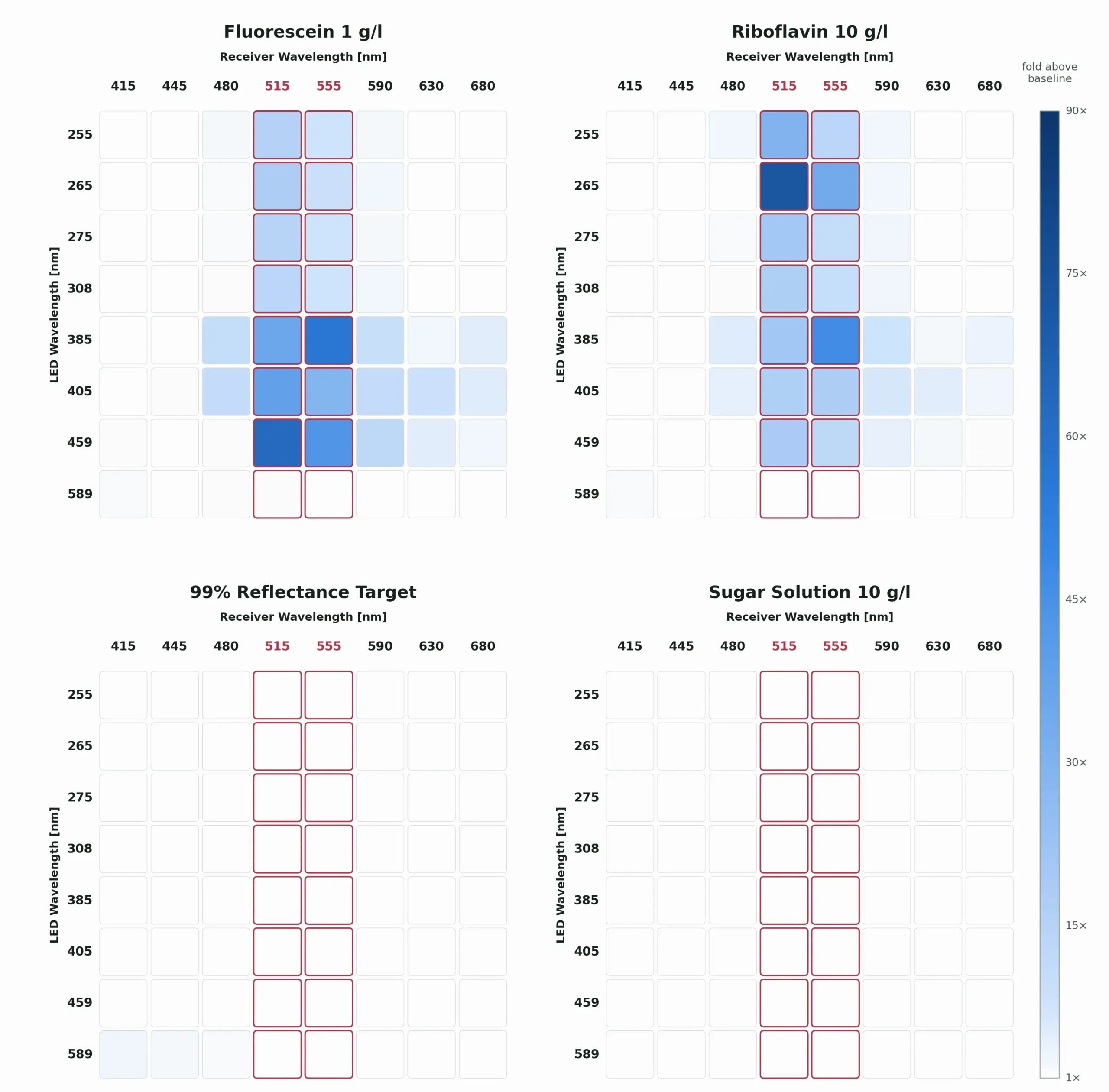
The application-specific ScanCorder used in this experiment features various excitation and emission bands. The highest primary fluorescence signals are obtained for the following pairs: [459 nm:515 nm] for Fluorescein and [265 nm:515 nm] for Riboflavin. Besides these, several secondary fluorescence signals are obtained. Refer to the colour-coded scale that shows the fold above baseline, which in this case is the solvent water (no fluorescence, signal normalised to 1.0). For a further reference, the signal obtained from a 99% reflectance pad, which is typically used as an upper bound for normalisation in reflectance measurements, is shown here as well.
This clearly demonstrates that the signal, which is significantly higher (up to 90 times) than the pure reflectance, is caused by a fluorescence effect.
Application-specific optical sensing
One of the main advantages of this approach is its configurability, which is a fundamental feature of all ScanCorder sensor designs. Since excitation and detection are based on individually selectable wavelength bands, a fluorescence ScanCorder can be designed to match the spectral characteristics of a specific application.
This is particularly useful when only certain excitation and emission bands are relevant. This is often the case in real-world applications. Rather than conducting a full hyperspectral measurement, a compact, tailored sensor can focus on the wavelengths that provide the most useful information for the given application.
Fluorescence measurement offers particularly promising opportunities in crop plant research and AgTech, where subtle changes in plant physiology and biochemistry can provide early indicators of plant stress, often specifically disease and plant–pathogen interactions. Specific fluorescence signatures can support the early detection of fungal and bacterial infections in crops, seeds, fruits, and beyond.
Fluorescence measurements can also be used to validate fluorescent staining and tracers for investigating plant–microbe interactions, such as endophyte colonisation.
Together, these applications demonstrate the potential of application-specific fluorescence sensing for non-invasive plant phenotyping in general, with a strong focus on crop health monitoring and early disease detection.
Summary
Fluorescence is a natural technological and business extension of the ScanCorder platform, complementing its well-established reflectance-based sensing capabilities. Although fluorescence applications are expected to be more specialised than the broader range of reflectance applications, the combination of compact hardware, configurable wavelength channels, and inverted spectroscopy offers great potential for application-specific optical sensing in biochemical and biomedical areas and beyond.
This development shows that different optical modalities can be integrated into a generic, handheld sensing platform capable of capturing complementary information according to the requirements of the underlying application, demonstrating the broader potential of the ScanCorder sensor architecture.


This work was partly funded by the German Federal Ministry of Research, Technology and Space under project number 03WIR7311B.